Licensed vs Unlicensed in Oregon
Summary of what it means for me:
Working with unlicensed contractors in the state of Oregon, simply means that you are working with an individual or company who simply has chosen to engage in criminal activities. As of January 2026 (has been this way for many years) the Oregon CCB webpage states “Generally, Oregon law requires anyone who works for compensation in any construction activity involving improvements to real property to be licensed.” With the only exceptions being gutter cleaning, power/pressure washing, debris cleanup (yard or construction).
Now, if you ask AI if you need a license in Oregon, it may report that if the projects are under $1000 and you don’t advertise, that a handyman would not need an Oregon CCB license. This is incorrect and false according to the Oregon CCB office that I reached out to for clarification. If you look at the picture below which is a screenshot from the Oregon CCB webpage, any and all services of any construction or handyman type work require an Oregon CCB license. There is an exception: a person is allowed a one time event to help a neighbor or relative with this type of work for money. This is not one time per customer, it is one time per person performing the work.
How does a licensed Handyman benefit me?
Once a person/company becomes CCB licensed, then they are also required to prove each year that they have an active and adequate liability insurance policy and bond (see bonds here). Having the ability to protect your residence and project with insurance other than your own is the biggest benefit to your peace of mind. Let’s face it, there are many stories of less than honorable contractors who run off with the deposit, don’t finish the project, become injured on your property and sue you in court, and more. Having a licensed contractor helps to put those stressors to rest. A bond is an insurance policy of sorts that if the project is not finished, then the state of Oregon will direct you to the insurance company of the bond to hire another contractor to finish the work up to the bond dollar amount. So a bond of $25,000 is how much the insurance company will spend towards finishing your project. If you have a large project, you can request that your contractor provide documentation of a large bond value.
Why doesn’t every contractor become licensed?
I ask myself that question as well. My only guess is that they don’t have the ability to maintain their insurance policy and bond requirements. The test is an open book test! It also requires that to maintain your license status that ongoing education is completed to keep each licensed contractor up to date on new regulations and best practices for successful businesses.
Many unlicensed contractors that I have encountered offer up reasons of :
Big brother government watching
They read on the internet that they don’t need it for the type of work they do
They were licensed at one time and lost their licensed or had it suspended and are not currently eligible for a CCB license and are working illegally.
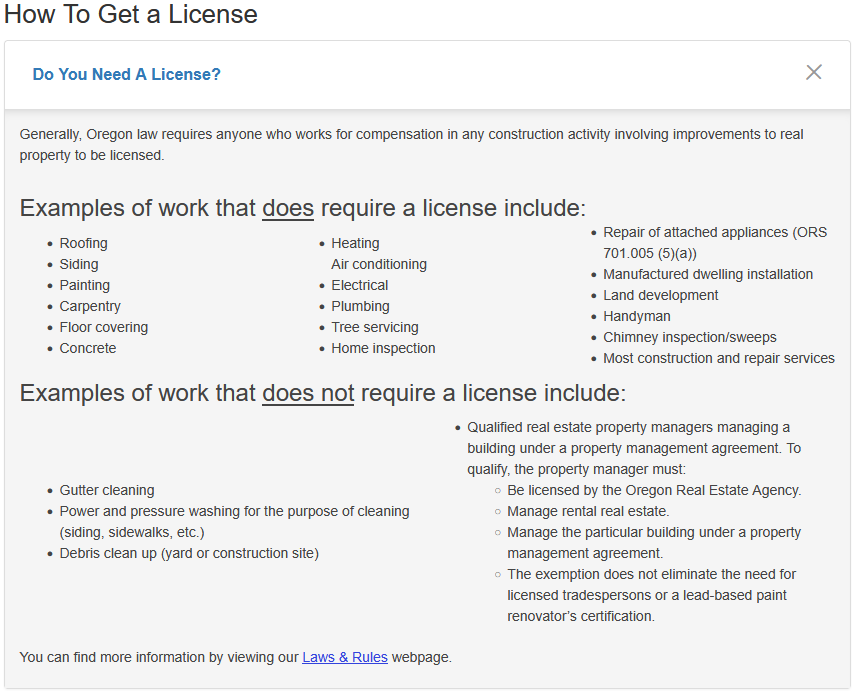
screenshot of Oregon CCB webpage listing who is required to have a CCB license.